by Dave Akers, IHSA
“Have you ever noticed that anybody driving slower than you is an idiot, and anyone going faster than you is a maniac?” — George Carlin
Navigating the ocean freight market right now is a masterclass in managing volatility. As of mid-May 2026, ocean container carriers are aggressively manipulating capacity on both coasts to defend freight rates against a backdrop of geopolitical tension, rising fuel costs, and unpredictable demand.
Here is the current state of the transpacific trade to the U.S. West Coast and the carrier landscape on the U.S. East Coast, with a specific look at ZIM’s market position.
Transpacific Trade to the U.S. West Coast (USWC)
Carriers servicing the Asia-to-USWC route are currently operating with a highly defensive capacity strategy. Instead of letting excess vessel supply dilute rates, alliances are leaning heavily into voided (blank) sailings to artificially tighten the market ahead of the traditional summer peak season.
- Aggressive Blank Sailings: Carriers are actively scrubbing scheduled voyages. For example, in mid-May 2026, major lines like Ocean Network Express (ONE) announced a fresh wave of canceled transpacific sailings (including the PS7, PN3, and VSE services to major Pacific South and Pacific Northwest gateways) stretching into late June and July.
- Propping Up Spot Rates: This artificial scarcity is working for the carriers. Transpacific spot rates to the West Coast have increased since late February, currently sitting around $3,400 per 40ft equivalent unit (FEU). This increase is driven primarily by capacity management and emergency fuel surcharges, rather than a massive boom in organic consumer demand.
- Operational Re-routing: The ongoing geopolitical disruptions in the Middle East (specifically around the Strait of Hormuz and the Persian Gulf) continue to absorb global vessel capacity. Carriers are keeping schedules tight, and there are active reports of rolled cargo at Far East origin ports as space becomes artificially constrained.
Carrier Position on the U.S. East Coast (USEC) and ZIM’s Strategy
The U.S. East Coast is seeing similar capacity management, with Asia-USEC spot rates hovering around $4,500 per FEU. However, the carrier landscape here, particularly regarding ZIM, is undergoing massive structural and operational shifts in 2026.
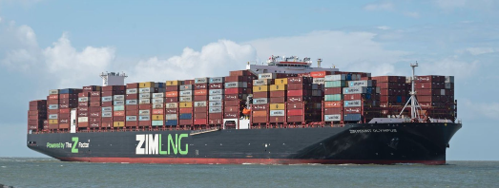
ZIM has historically maintained a strong, specialized foothold on the East Coast, and their current strategy revolves around environmental modernization, strategic alliances, and major corporate consolidation:
- The Hapag-Lloyd Acquisition: The biggest news defining ZIM’s 2026 position is the corporate buyout. In February 2026, it was announced that Hapag-Lloyd is acquiring ZIM for approximately $4.2 billion. While a spin-off entity (“New ZIM”) will retain a portion of the business, this merger is set to heavily consolidate carrier power and network routing on the East Coast once fully integrated.
- The LNG Fleet Advantage: ZIM is currently uniquely positioned as the only liner servicing the strategic Asia-to-USEC trade lane with liquefied natural gas (LNG) powered vessels. They deployed 10 highly efficient, 15,000 TEU LNG vessels on their flagship ZCP service. This creates a distinct “moat” that protects their margins against volatile traditional bunker fuel prices and allows them to charge a “green premium” to major U.S. retailers looking to hit emissions targets.
- Network Restructuring: To shore up their Atlantic reliability, ZIM has restructured its cross-Atlantic direct services (the ZCA and ZCT routes). These revamped services focus on direct transit from Mediterranean ports (like those in Turkey, Italy, and Spain) straight to New York, Norfolk, and Savannah.
- Incoming Surcharges: Shippers utilizing ZIM and other USEC carriers should prepare for immediate cost layers. Carriers are instituting updated Green Fuel Surcharges (GFS) and New Emission Fees (NEF) effective June 1, 2026, passing the costs of EU Emissions Trading System (ETS) compliance and alternative fuels directly onto the cargo owners.
The Bottom Line
Carriers on the West Coast are utilizing aggressive voided sailings to choke capacity just as an unexpected, early peak-season demand surge hits the water. On the East Coast, players like ZIM are leveraging advanced, fuel-efficient vessels to maximize margins on rising rates while the industry undergoes massive corporate consolidation.
IHSA
Navigating this highly volatile, front-loaded market requires constant vigilance and a strategic approach to carrier relations. While the landscape shifts rapidly, IHSA members can move into June with the confidence that their logistics foundation is backed by collective scale. If you are not currently an IHSA member and want to learn how our shared volume, contracted protections, and deep industry expertise can help your supply chain from sudden rate spikes, please reach out to team@shippersassociation.org for more information.